Reading access & word recognition
Build efficient access to print, symbols, morphology, decoding, word recognition, and fluency where each component is instructionally relevant.
 My Journey CurriculumStart a conversation
 Accessible literacy
Arizona standards define meaningful literacy outcomes. The learner’s communication, sensory, motor, language, and cognitive access profile shapes how each lesson is taught—and how understanding can be shown.
Standards are the destination
My Journey begins with an age-respectful text or authentic literacy purpose, identifies the essential Arizona standard, and then removes barriers to engagement, representation, action, and expression. A learner is never assigned a younger identity because they need foundational instruction.
Free visual communication resource
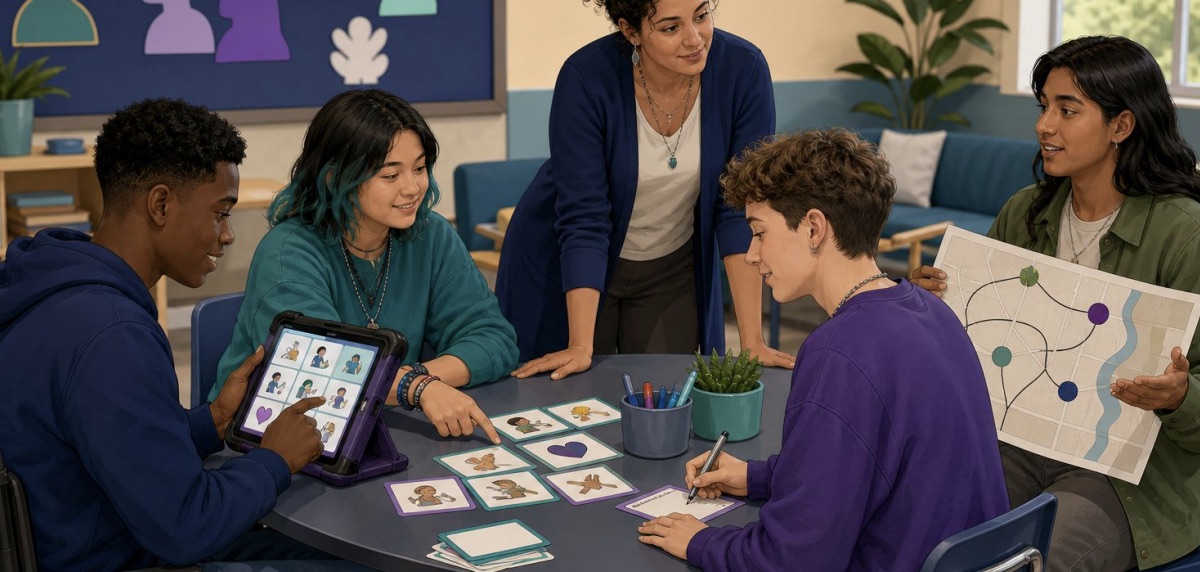
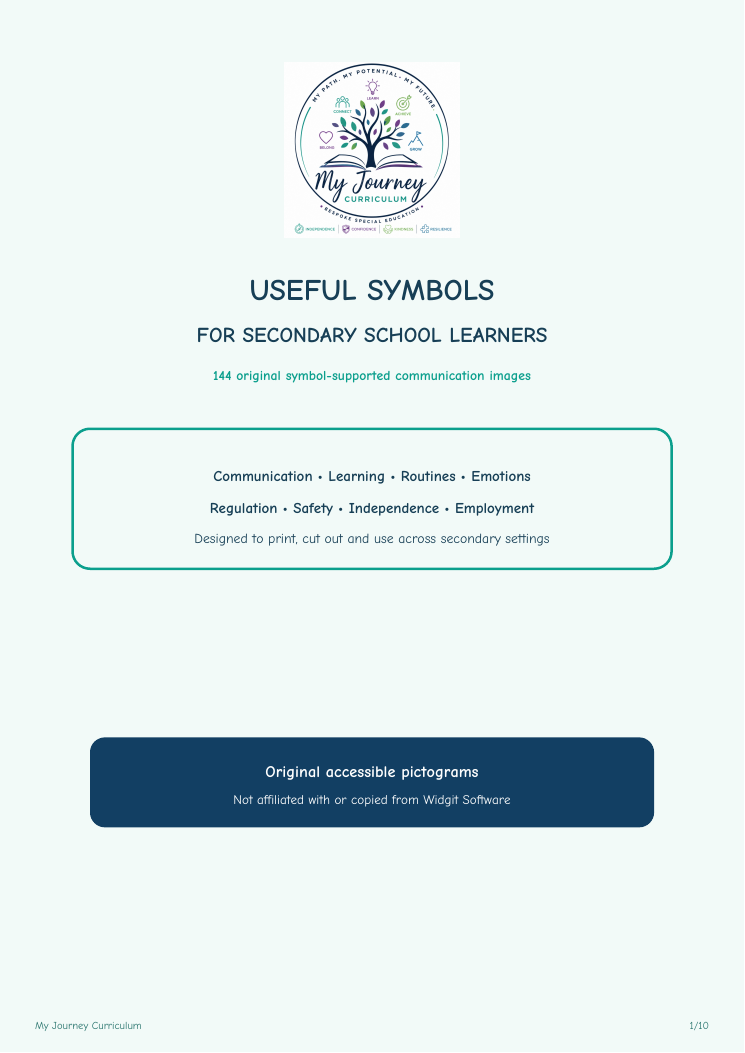
Download a ready-to-use collection of original visual supports created for secondary learners. The bank can support understanding, choice, communication, routines, regulation, safety, independence, and preparation for adult life.
10 pages · 144 symbols · A4 · print, cut, and use
Six connected strands
The strands draw from Arizona’s Reading, Writing, Speaking and Listening, and Language standards, then connect them to the authentic literacy demands learners meet across school, community, work, and adult life.
Build efficient access to print, symbols, morphology, decoding, word recognition, and fluency where each component is instructionally relevant.
Identify key ideas and details, examine craft and structure, integrate information, and build knowledge through age-respectful texts.
Create narrative, informative, explanatory, and opinion or argument texts through handwriting, typing, AAC, dictation, symbols, or shared construction.
Participate in collaborative conversations, understand information presented in different media, and communicate ideas clearly using a reliable response mode.
Develop word knowledge, syntax, conventions, and flexible use of academic and functional language without confusing speech production with understanding.
Use literacy to navigate schedules, forms, safety information, digital media, workplace texts, community information, research, and self-advocacy.
One concept · three fluid routes
Routes change the entry point, representation, response demand, and level of independence. They do not become permanent learner labels.
Make text, language, and meaning reliably accessible.
A consistent response, meaningful choice, recognition, anticipation, or connection—with access conditions recorded.
Strengthen comprehension, expression, and strategic independence.
Increasing accuracy, initiation, explanation, reduced prompting, and use of a strategy across more than one example.
Use literacy to analyze, create, advocate, and participate.
Purposeful transfer to a new text, audience, setting, or authentic communication need.
EngageNY-informed lesson architecture
My Journey adapts the strongest structural features of the open EngageNY modules—clear targets, complex text, vocabulary, modeling, evidence-based discussion, writing, assessment, and reflection—through an access-first special education lens.
Activate knowledge, establish the purpose, preview vocabulary, and make the communication and access plan visible.
Read, listen, watch, or explore a short high-quality text while the educator models a useful comprehension or composition process.
Reread, discuss, sequence, annotate, sort, dramatize, map, or answer using the learner’s strongest available response modes.
Communicate an idea, construct a text, cite evidence, ask a question, or complete an authentic literacy action.
Name what helped, revisit the learning target, and use the idea with one carefully planned change in text, person, tool, or setting.
Example outcome pathway
The standard-connected idea stays shared: readers locate, interpret, and use information for a real purpose.
Notice the date, place, key symbol, and purpose of a community event notice; choose whether it is relevant.
Identify the main message and two details; use the information to answer a question or add the event to a schedule.
Compare two notices for clarity and accessibility, then create or revise one for a chosen audience.
Alignment & attribution
This developing framework is connected to the Arizona English Language Arts Standards and informed by Arizona’s guidance on academic achievement, inclusive practices, UDL, and specially designed instruction. Its lesson architecture is informed by the archived EngageNY ELA modules. My Journey Curriculum is independently developed and is not endorsed by ADE or NYSED.
Structure in development
Strand progressions, unit-level standards, lesson plans, assessments, and accessible resources will be added as the literacy curriculum is mapped.
Discuss accessible literacy