Number sense & quantity
Develop magnitude, counting, place value, integers, rational numbers, estimation, and flexible representation of quantity.
 My Journey CurriculumStart a conversation
 Accessible mathematics
Arizona standards provide coherent mathematical progressions. My Journey makes those ideas visible, touchable, communicable, and useful—without treating speed, handwriting, or mental calculation as the only evidence of understanding.
Understanding before performance
Every lesson identifies the essential mathematical relationship, begins from what the learner can already notice or do, and connects concrete experience, visual representation, language, and notation. Tools and accommodations support reasoning; they do not invalidate it.
Six connected strands
The strands organize Arizona’s grade-level domains and high-school conceptual categories into a flexible instructional architecture. Precise standards will be mapped within each unit and learner pathway.
Develop magnitude, counting, place value, integers, rational numbers, estimation, and flexible representation of quantity.
Understand operations, patterns, expressions, equations, variables, functions, and the relationships that make procedures meaningful.
Compare quantities, reason with rates, percentages, scale, and proportional relationships in visual and authentic contexts.
Measure, compose, decompose, locate, transform, and reason about space, shape, units, perimeter, area, volume, and coordinate systems.
Ask statistical questions, collect and represent data, interpret variability, evaluate claims, and reason about likelihood and risk.
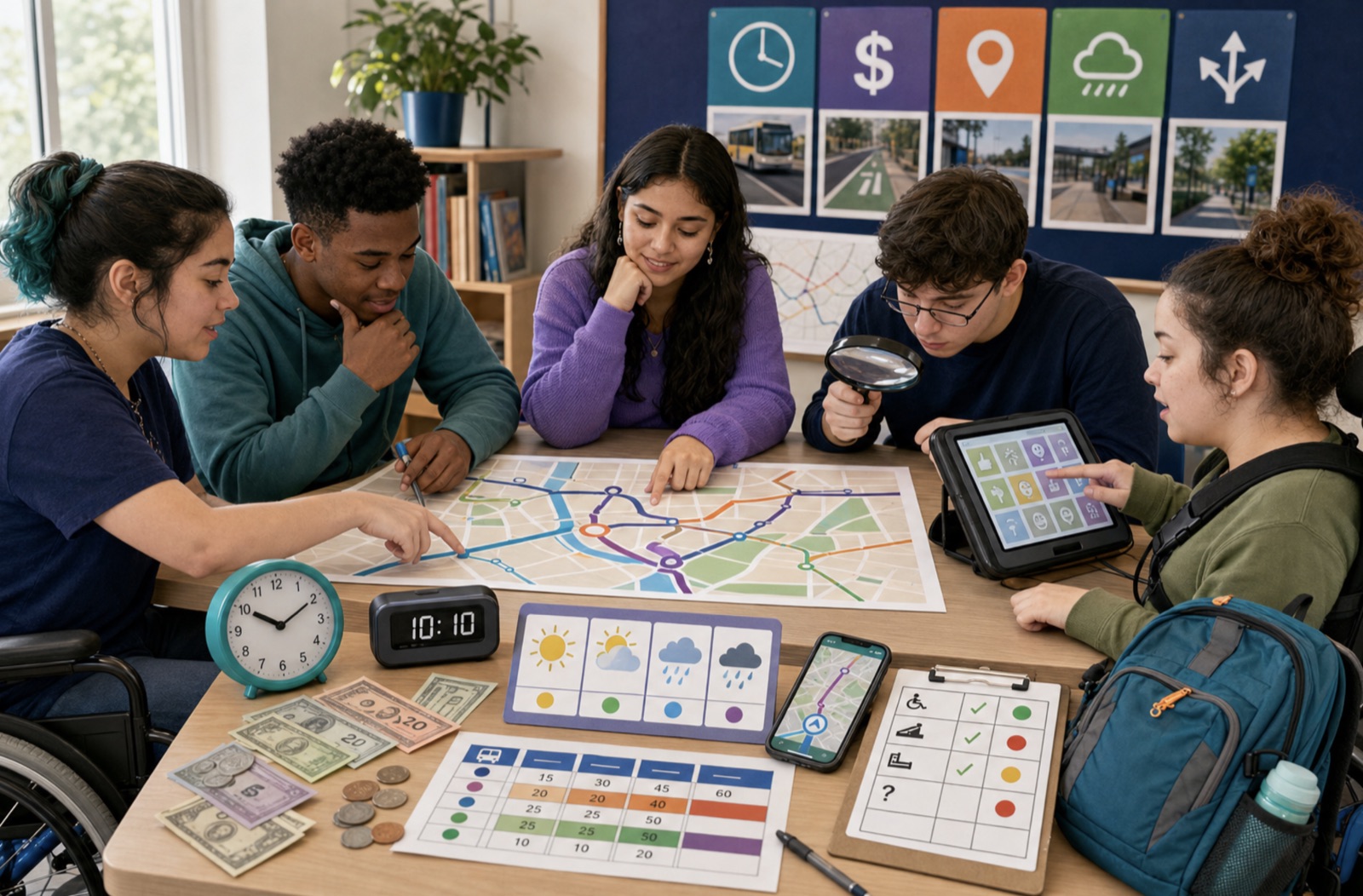
Use time, money, schedules, budgets, comparison, change, distance, and estimation to make informed decisions in school, work, home, and community life.
Arizona Standards for Mathematical Practice
The eight mathematical practices are taught in connected pairs so educators can see reasoning beyond the final answer and learners can build a durable problem-solving identity.
Understand the situation, choose a starting point, monitor progress, and decide whether an answer is reasonable.
Move between quantities and representations, notice relationships, justify a decision, and respond to another person’s reasoning.
Represent with objects, drawings, diagrams, tables, graphs, equations, technology, calculators, or assistive tools chosen for purpose.
Communicate quantities and units clearly, notice repeated patterns, and use structure to make a problem more manageable.
One concept · three fluid routes
A learner may use one route for number and another for geometry or data. Route decisions come from current evidence, not a fixed label.
Build meaning through concrete experience and reliable response.
A meaningful comparison, choice, action, representation, or consistent response under known access conditions.
Connect representations, strategies, and mathematical language.
Greater strategy use, accuracy, explanation, independence, and connection across representations.
Use mathematics to reason, decide, design, and advocate.
Transfer of mathematical reasoning to a new problem, tool, environment, or consequential decision.
EngageNY-informed lesson architecture
My Journey adapts EngageNY’s coherent mathematics lesson sequence while protecting processing time, conceptual understanding, multiple representations, assistive tools, communication access, and authentic application.
Revisit a small, useful relationship through accessible practice. Fluency means efficient strategy use—not timed performance.
Begin with a short, relevant situation that activates prior knowledge and gives the mathematics a purpose.
Model and investigate the essential idea through concrete, representational, and abstract forms with explicit language and tools.
Solve, represent, compare, or explain with responsive prompting, feedback, and planned opportunities for choice.
Discuss what worked, connect representations, revisit the target, and apply the idea with one meaningful change.
Example outcome pathway
The standard-connected idea stays shared: use quantities, operations, comparison, estimation, and reasoning to make a defensible decision.
Match items to prices, compare more and less, and choose whether a small set of items fits within a visual spending limit.
Add item prices, estimate the total, compare it with a budget, and explain one adjustment using a calculator or chosen representation.
Build and justify a weekly grocery plan, compare unit prices or alternatives, and revise the plan when one condition changes.
Alignment & attribution
This developing framework is connected to the Arizona Mathematics Standards and informed by Arizona’s guidance on academic achievement, inclusive practices, UDL, and specially designed instruction. Its lesson architecture is informed by the archived EngageNY mathematics modules. My Journey Curriculum is independently developed and is not endorsed by ADE or NYSED.
Structure in development
Strand progressions, unit-level standards, lesson plans, assessments, manipulatives, and accessible resources will be added as the mathematics curriculum is mapped.
Discuss accessible math